Wan 3.0 — Longer Stories and More Reference Options
Generate videos up to 30 seconds with native audio, supported multimodal references, and document or webpage inputs in compatible workflows.


Which AI video model should you choose?
Wan 3.0 and MiniMax H3 both support multimodal AI video generation with native audiovisual capabilities, but they serve different creative needs.
Choose Wan 3.0 when your project needs up to 30 seconds in one generation, a larger set of references, or document and webpage inputs through supported workflows. Consider MiniMax H3 when you need a focused 5–15-second video, an available 2K regeneration workflow, or downloadable model weights for an eligible custom deployment.
Compare the supported specifications, six side-by-side video examples, and generation costs below. Neither model is automatically better for every creative task.
Wan 3.0 — Longer Stories and More Reference Options
Generate videos up to 30 seconds with native audio, supported multimodal references, and document or webpage inputs in compatible workflows.
MiniMax H3 — Short-Form Video and 2K Regeneration
Create audiovisual clips up to 15 seconds with native stereo sound, reference-guided generation, and an optional high-resolution regeneration path.
Available settings, generation modes, and credits may vary by account and workflow. Check the live generator before rendering.
The main trade-off is longer video generation and a larger reference budget versus shorter clips with a dedicated 2K regeneration workflow and licensed downloadable model weights. The following comparison distinguishes upstream model capabilities from the settings available through Topview.
| What You're Comparing | Wan 3.0 | MiniMax H3 |
|---|---|---|
| Developer | Alibaba | MiniMax |
| Model Type | All-in-one multimodal video generation model | Omni-modal audiovisual generation model |
| Model Availability | Officially available through Alibaba Cloud Model Studio | Hosted API and published H3-Base weights |
| Video Duration | Up to 30 seconds | 4–15 seconds upstream; 5–15 seconds on Topview |
| Resolution on Topview | 480p / 720p / 1080p | 480p / 768p / 1440p, with a supported workflow |
| High-Resolution Generation | Up to 1080p in the documented workflow | 768p base generation followed by H3-Regenerate-2K where available |
| Text to Video | Supported | Supported |
| Image to Video | Supported | Supported |
| Reference Images | Up to 10 | Up to 9 |
| Reference Videos | Up to 5 | Up to 3 |
| Reference Audio | Up to 5 | Up to 3 |
| Total Mixed Inputs | Up to 20 under the documented limits | Up to 12 files |
| Native Audio | Dialogue, music, and sound effects | Native stereo audiovisual output |
| Document / Webpage Inputs | Supported in designated upstream modes | No equivalent dedicated upstream doc/link mode listed |
| Editing & Control | Reference-guided generation, video editing, and extension in supported workflows | Multimodal guidance, motion reference, model-dependent editing |
| Output Aspect Ratios | 16:9, 4:3, 1:1, 3:4, 9:16 and adaptive options | Includes 21:9, 16:9, 4:3, 1:1, 3:4, 9:16 |
| Deployment | Hosted through supported platforms and APIs | Hosted API and downloadable H3-Base subject to license |
| Best Starting Point | Longer narratives, reference-rich projects, document-led concepts | Short audiovisual clips, high-resolution regeneration, eligible custom pipelines |
MiniMax H3 supports up to 9 reference images, 3 reference videos, and 3 reference audio files, but the combined number of uploaded files cannot exceed 12. Audio references cannot be used as the only reference input. MiniMax H3's 2K output is generated through H3-Regenerate-2K rather than directly by the 768p base model. Downloadable model weights are subject to MiniMax's community license, including applicable territorial and commercial restrictions.
Sources: Topview Wan 3.0 API · Topview MiniMax H3 API
Choose the model that best fits your creative brief, reference requirements, output length, and delivery workflow.
Wan 3.0 is a natural starting point for longer, reference-heavy video production. MiniMax H3 is worth considering for shorter audiovisual scenes, detail-sensitive output, and eligible custom integrations.
Build an opening, development, and conclusion within one generation. A longer continuous video gives product demonstrations, brand stories, explainers, and cinematic scenes more room to develop without stitching together several shorter clips.
Use up to 20 supported reference items, including images, video clips, and audio files, within the documented limits. Guide character identity, product details, environments, motion, and sound using a larger collection of source materials.
Use reference-guided generation to define characters, locations, props, and visual styles across a longer narrative. Evaluate whether the generated video preserves important details as camera angles, actions, and environments change.
Wan 3.0's upstream workflow supports designated document and webpage-link inputs. Use provided source materials to develop video concepts, explainers, and visual stories. Check whether the selected Topview workflow supports these input options. A webpage link is not the same as unrestricted live internet search.
Create focused 5–15-second clips and use H3's supported high-resolution regeneration workflow when detailed output is required. This can be useful for product close-ups, cinematic compositions, and short commercial visuals.
Generate audio and video together, including supported dialogue, music, and sound effects. Review the resulting speech, lip synchronization, and soundtrack timing before using the clip in production.
Combine supported image, video, and audio references within H3's 12-file mixed-input limit. A smaller reference set may be enough for character-driven scenes, motion-guided videos, and short creative concepts.
MiniMax publishes H3-Base weights for appropriately licensed deployment and development. Review the current community license, territorial restrictions, infrastructure requirements, and API-dependent components before using the model in a private system.
Six Creative Briefs. Two AI Video Models. Compare the Details That Matter.
Explore six existing side-by-side video examples featuring cinematic visual effects, dialogue, multi-character acting, music synchronization, literary storytelling, and complex game action. Each case presents the original creative task, relevant reference assets, and outputs from Wan 3.0 and MiniMax H3.
Watch how each model interprets the same creative challenge. Compare instruction following, reference consistency, motion, sound, and narrative completion rather than judging a model from one attractive frame.
Text to Video · 15s · 16:9
A Norse-inspired hero hovers above a fractured obsidian shrine as golden lightning, floating stone fragments, and glowing runes build toward the formation of a massive battle hammer. The original brief requires a continuous orbital camera movement, a dramatic shockwave, and a final wide hero composition. This test examines whether both models can coordinate complex visual effects, character motion, and camera direction within one cinematic sequence.
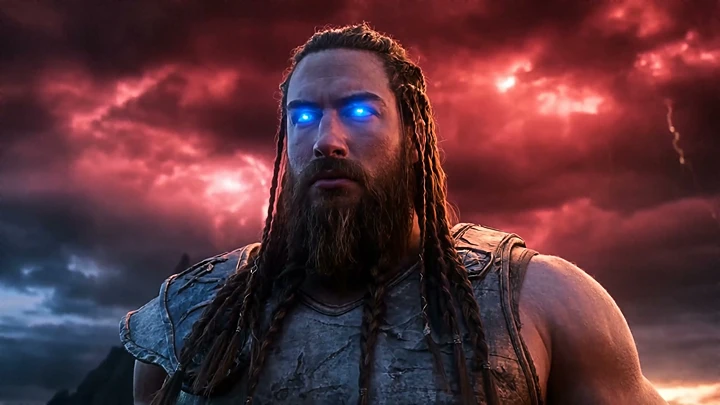
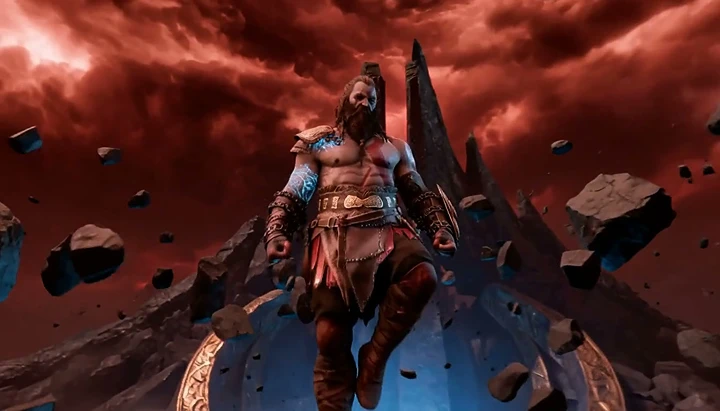
Complex VFX generation requires more than visually impressive effects. The model must maintain a logical action sequence while coordinating movement, lighting, camera direction, and object interactions. This test reveals how each model handles cinematic effects that depend on multiple connected actions.
Wan 3.0 keeps a readable Norse hero identity in the checked frames: braided hair, weathered armor, and the glowing blue-eye beat land as one continuous character read. MiniMax H3 opens wider on a rune platform with floating debris and a more theatrical tableau, but the framing jumps between wide, close, and vortex-like beats, and the hero's clothing is less stable across samples. Choose Wan 3.0 when the same face and armor have to survive the escalation. Choose MiniMax H3 when a shorter effects montage with a wide shrine composition is enough and cuts are acceptable. Neither sampled set clearly proves a completed unbroken 360-degree orbit.
A high-concept mythological action VFX cinematic spectacle shot on Sony Venice 2 with Cine Alta 8K sensor and Leica Summilux-C lenses, featuring photorealistic golden lightning arc flashes, dynamic ray-traced particle physics, floating terrestrial debris, and glowing ancient divine runes illuminated by hyper-detailed volumetric atmosphere. The continuous, seamless 360-degree whip-pan camera begins in a low-angle orbital sweep around a muscular, bearded Norse god suspended in mid-air above a fractured obsidian mountain shrine under a tempestuous crimson sky. His initial solemn and stoic composure dramatically shifts into furious rage as his eyes burst into blinding blue plasma energy, casting vibrant specular highlights across his weathered skin and braided hair. As the camera accelerates its continuous spiral rotation around the god, he lets out a guttural, thunderous roar, raising his right hand to summon violent streaks of celestial lightning that erupt from swirling storm clouds. The raw electrical arcs violently pull floating stone fragments and divine liquid metal together into a swirling vortex, instantly fusing them into a massive, glowing, runic-engraved battle hammer in his fist. Upon gripping the weapon, he detonates a massive radial gravity shockwave that instantly pulverizes the surrounding floating boulders into fine stardust particles and ripples through the thick atmosphere, leaving the ancient fractured shrine beneath him pulsing with deep blue subterranean magic. The unbroken dynamic shot completes its orbital loop to settle into a dramatic wide hero framing of the god hovering amidst the dissipating energy dust, legendary, majestic, thunderous, and escalating from tense stillness to an overwhelming explosive climax.
Multi Reference · 3 Images · 15s · 16:9
Two stylized animated characters, HAORAN and XIAOYU, meet unexpectedly outside a café, exchange four specified English dialogue lines, and enter the building together. Three image references define both characters and the café environment. The prompt also requires natural facial expressions, consistent character designs, a slow camera push-in, and a specific outward-opening door action.
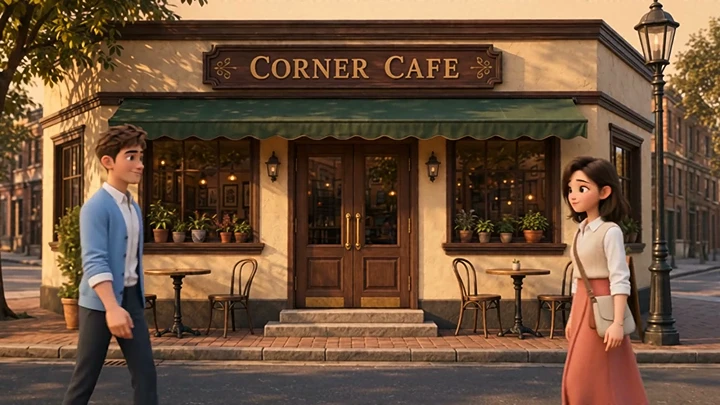
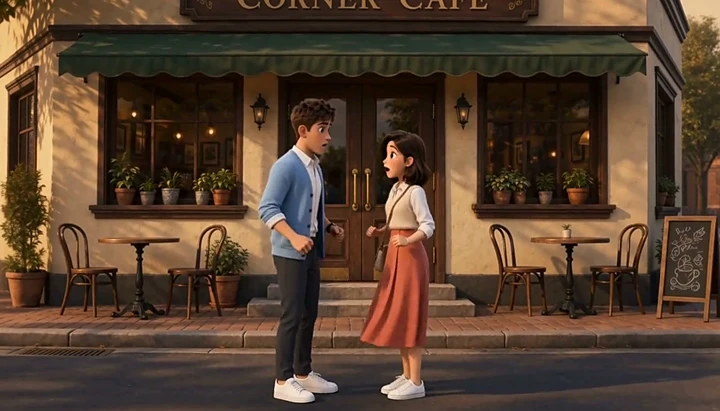
Character-driven video requires several elements to work together: dialogue, facial performance, physical movement, reference fidelity, and scene continuity. A convincing dialogue clip should preserve both the spoken content and the physical interactions specified in the creative brief.
Both clips keep stylized HAORAN and XIAOYU outside the Corner Cafe — blue cardigan, cream vest, salmon skirt, and the cafe awning stay recognizable — and both travel from the street toward the door. Wan 3.0's later frames show him at the brass handle while she moves through an open doorway, which is closer to the outward-door entrance in the brief. MiniMax H3 shows the face-to-face exchange and her turn toward the door while he is still beside her, without a clear held-open outward door. Use Wan 3.0 when the entrance action is part of the brief. Use MiniMax H3 when a short cafe conversation is the goal.
Reference Assets
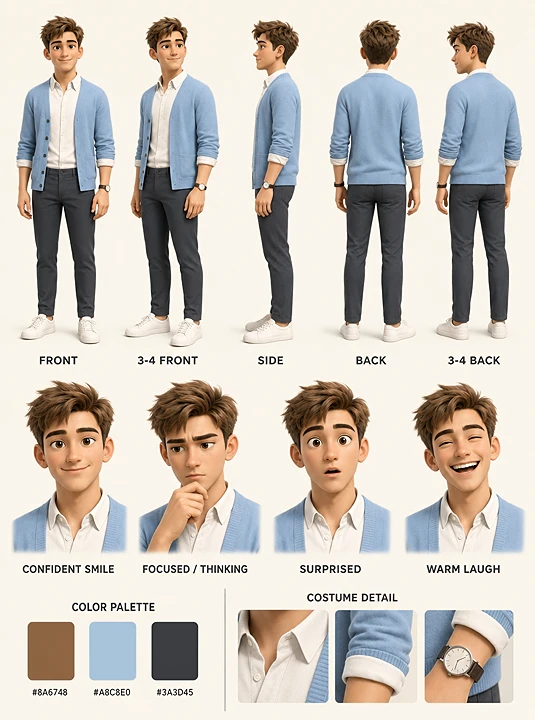
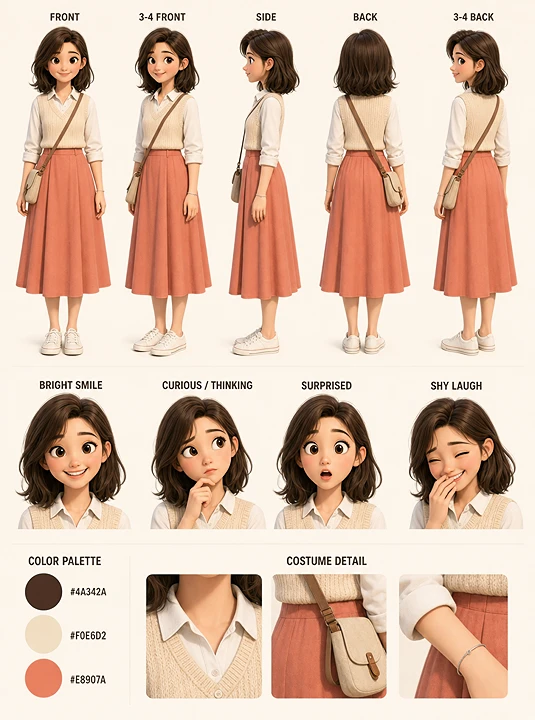
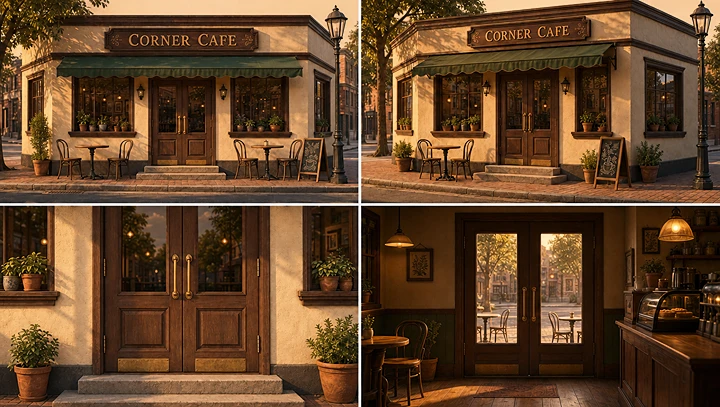
Pixar-style 3D animation, style locked to <<<Image3>>> , <<<Image1>>> and <<<Image2>>> — render everything exactly in their look. HAORAN, the young man from <<<Image1>>> , and XIAOYU, the young woman from <<<Image2>>> , run into each other on the sidewalk in front of the café from <<<Image3>>> , both breaking into surprised, warm smiles. XIAOYU says: "Haoran? What a coincidence!" He laughs: "First time seeing you since graduation!" She replies: "Come on in, coffee's on me." He answers: "Let's go." They walk up the steps together; HAORAN pulls the right door leaf outward by its brass handle — hinges on the outer edge — and holds it open as XIAOYU steps inside, then follows her in as the door swings shut behind them. Soft rounded stylized character proportions, subsurface scattering on skin, large expressive animated eyes, warm golden-hour cinematic lighting, gentle squash-and-stretch motion. The camera tracks them from across the street with a slow push-in. Dialogue in English with accurate lip sync, no subtitles. Avoid photorealistic faces, live-action look, 2D cel-shaded style, any style shift mid-clip, doors opening inward, sliding doors, or extra background characters entering frame.
Text to Video · 15s · 16:9
A group of expressive plush-style animal characters takes a chaotic road trip together. Inside the moving vehicle, each character performs different actions while road bumps, shifting hats, flying objects, and sudden turns produce a sequence of comedic reactions. The brief calls for a fixed interior camera angle, recognizable characters, consistent plush-felt styling, and coordinated cause-and-effect actions.
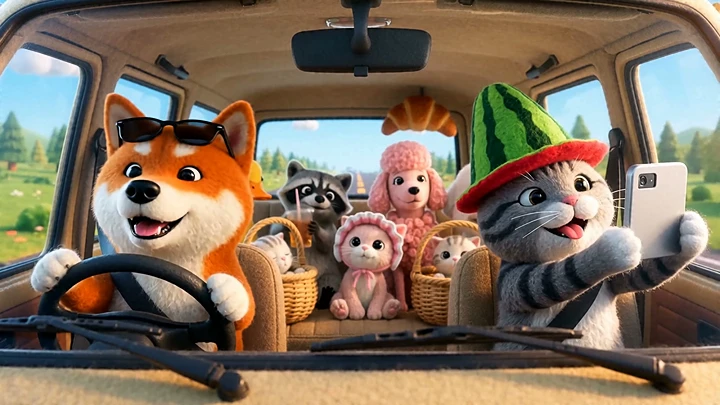
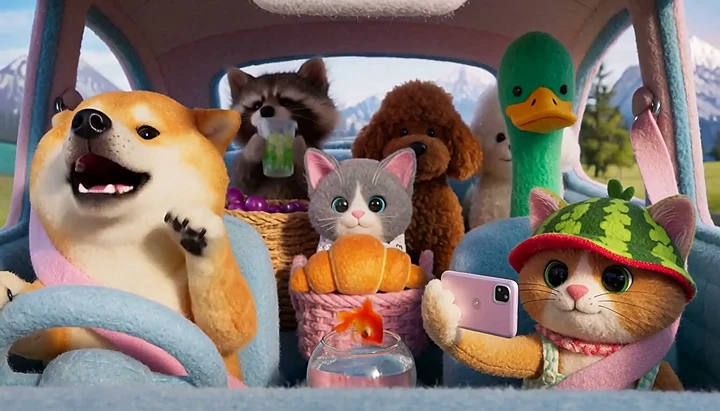
Multi-character scenes challenge AI video models to manage several independent actions simultaneously. The model must preserve individual identities while coordinating object movement, group reactions, and environmental changes within a shared space.
Wan 3.0 packs more of the requested gag chain into one cabin: the singing shiba, watermelon-hat selfie cat, raccoon with a drink, basket kittens, and a croissant beat stay visually distinct in the sampled frames, though the camera is not guaranteed to stay locked for the full 15 seconds. MiniMax H3 delivers a denser plush-felt look and a lively interior, but passenger identities, hats, and props swap more readily across frames, so the assigned jobs are harder to track. Choose Wan 3.0 when the comic chain reaction and a stable cast matter more. Choose MiniMax H3 when plush texture and cabin energy matter more than each animal keeping one job — then re-check identities before you ship.
Hyper-realistic wool-felt plush texture, cottagecore pastel palette, matching the reference image exactly. Fixed camera locked at this exact interior angle, no cuts, no camera movement. A hilarious and heartwarming 15-second road trip scene bursting with individual personality. [0-4s] The shiba inu driver is having the time of her life — head bobbing to music, singing loudly with mouth wide open, one paw drumming the steering wheel. The watermelon-hat cat films a selfie video, the duck photobombs by suddenly stretching its neck into frame with a loud honk, the cat rolls its eyes dramatically. The raccoon shakes its iced drink like a cocktail, ice cubes rattling. [4-8s] Sharp left turn! A comedic chain reaction: the croissant hat slides off the grey cat's head and lands on the bonnet kitten's face, covering its eyes — the kitten flails its tiny paws in confusion. The poodle slides across the back seat and squishes the bichon against the window, both bursting into laughter. The duck slides sideways with a deadpan expression, completely unbothered, like it has seen everything. [8-12s] Bumpy road! Everything bounces — a grape pops out of the picnic basket, flies through the air, and the raccoon catches it in its mouth mid-bounce, looking extremely proud of itself. One kitten in the pink basket gets bounced awake, grumpily grabs the edge of the basket, gives everyone an annoyed squint, then dramatically flops back down into the basket. The goldfish leaps out of the sloshing water and splashes back in. [12-15s] The road smooths out into warm golden light. All animals perk up, bright-eyed and alert, turning toward the camera with big open-eyed smiles — the shiba driver glances back with a wide grin and a thumbs-up paw, eyes sparkling; the croissant cat retrieves its hat, puts it on backwards without noticing, and blinks curiously at the camera; the bonnet kitten hiccups a tiny flower petal and giggles with wide shining eyes. Everyone stays awake, lively and energetic, eyes wide open, looking around cheerfully as sunset light glows on their fur. Every animal has exaggerated theatrical acting with natural fur physics — wide eyes, flattened ears, wagging tails, puffed cheeks, dramatic reactions, while rendering stays fully realistic plush-felt style throughout. All characters keep their eyes open and alert throughout, except the basket kittens. Blurred mountain scenery streams past the windows, tree shadows flicker across the interior.
Multi Reference · 1 Image + Audio · 15s · 9:16
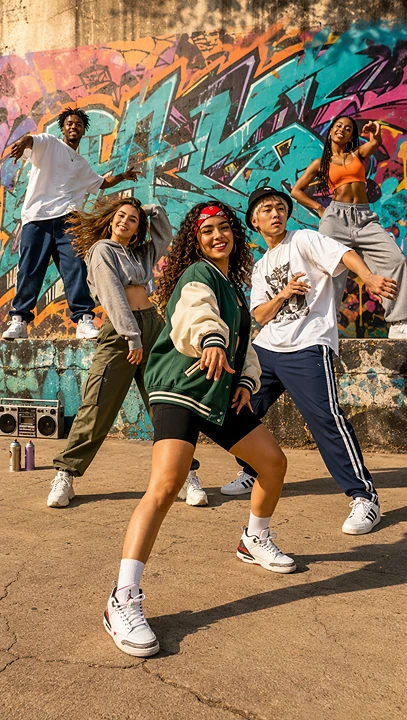
Five dancers perform a coordinated street-dance routine in a graffiti-covered plaza, using a reference image to preserve their appearance and an audio reference to guide the choreography. The routine begins in a V-formation before transitioning into a horizontal line. The original brief requires synchronized movement, consistent identities, and preservation of the supplied music within one continuous shot.
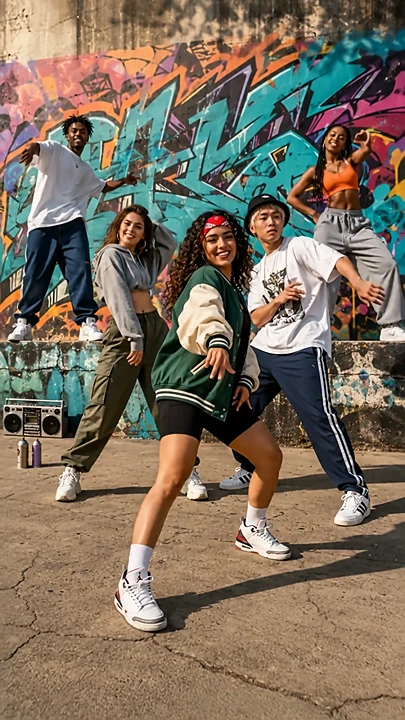
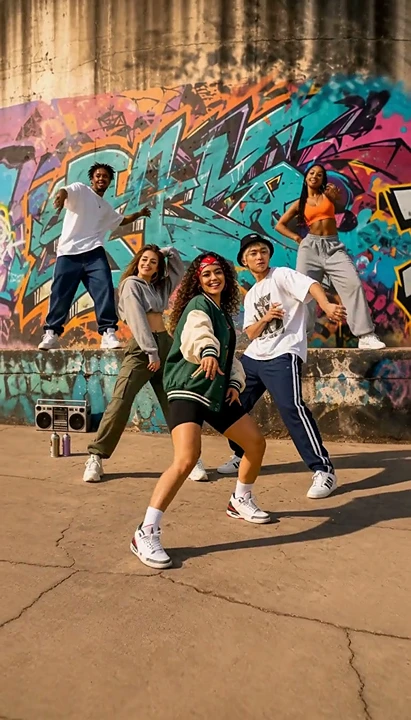
Dance generation requires a model to coordinate multiple performers, visual identities, spatial positions, and music timing. A compelling still frame cannot prove that the choreography remains synchronized across the complete clip. The actual timing and formation changes matter.
Wan 3.0 opens closer to the five-dancer reference: a V-like stance and the green varsity jacket read against the graffiti wall, but later frames can collapse toward a single dancer before a looser group returns. MiniMax H3 often starts with extra people and later swaps into a different line, so faces and outfits do not stay tied to one reference sheet. Neither result is a reliable five-dancer lock through the formation change. Prefer Wan 3.0 as the starting point when the opening must match the reference photo. Do not treat either clip as beat-synced until you play it against the uploaded track.
Reference Assets
Audio beat reference
The five dancers from <<<Image1>>> , keeping each dancer's exact face, hairstyle and outfit, perform street dance in the graffiti plaza, choreographed to the music in <<<Audio1>>> , every move landing on the beat. Formation change is required: starting in the V-formation from <<<Image1>>> , midway through the clip all five dancers travel to new positions — the center dancer moves to the back as the other four sweep forward into one horizontal line, finishing the routine in this new formation. Camera movement mirrors the music's rhythm and energy. Continuous single take. Use the ORIGINAL audio from <<<Audio1>>> unchanged; audio reference only, not visual reference. Avoid generated music, added sound effects, cuts, face distortion, identity swapping, subtitles, dancers standing in place for the whole clip.
Text to Video · 15s · 16:9
A watercolor-style animated adaptation of a riverside passage from Kenneth Grahame's The Wind in the Willows. A water rat rows a blue-and-white boat while a mole sits in the stern. The boat strikes the riverbank, causing the rat to tumble backward before recovering. The original literary passage is used to evaluate whether both models preserve character roles, event order, physical actions, and the requested Edwardian watercolor style.
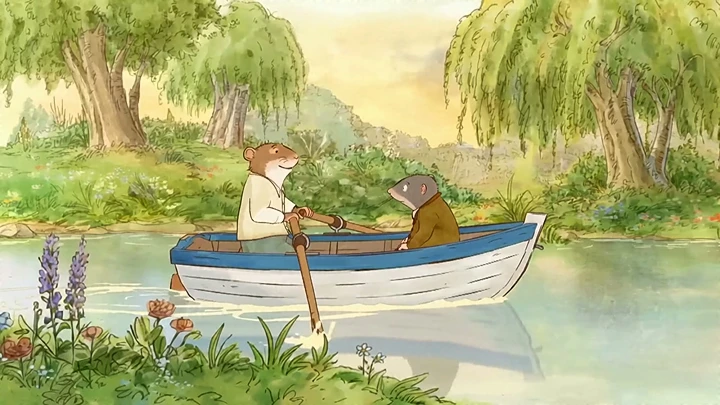
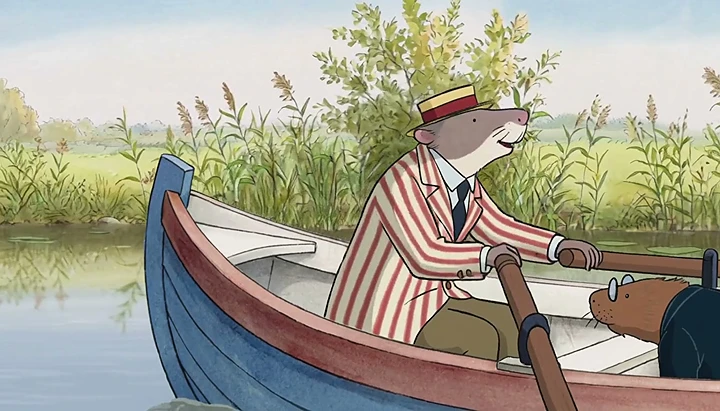
Literary adaptation tests how accurately an AI video model translates written storytelling into visual action. The objective is not simply to create attractive storybook imagery. The resulting video must preserve essential character roles and events so that the original narrative remains understandable.
Wan 3.0 is the stronger literary adaptation of the two. It keeps an Edwardian watercolor river, a boat that reads blue outside and white within, a water rat at the oars, and a mole as passenger under the willows — so character roles stay understandable. The heels-in-the-air tumble and recovery are weaker or missing in the checked frames. MiniMax H3 also stays in watercolor with a blue boat, but the rower is costumed like a person in a striped jacket and hat, so the rat/mole roles break down and the bank collision is harder to read as the cause of a fall. Choose Wan 3.0 when roles and storybook style matter. MiniMax H3 is the weaker adaptation of this passage.
Original Source: Kenneth Grahame, The Wind in the Willows (1908), Chapter I. Public-domain text available through Project Gutenberg.
"Believe me, my young friend, there is nothing—absolute nothing—half so much worth doing as simply messing about in boats. Simply messing," he went on dreamily: "messing—about—in—boats; messing—" "Look ahead, Rat!" cried the Mole suddenly. It was too late. The boat struck the bank full tilt. The dreamer, the joyous oarsman, lay on his back at the bottom of the boat, his heels in the air. "—about in boats—or with boats," the Rat went on composedly, picking himself up with a pleasant laugh." — Kenneth Grahame, The Wind in the Willows (1908), Chapter I, Project Gutenberg #27805 (Scribner 1913 ed.)
A fifteen-second continuous shot, Edwardian pastoral watercolor style, soft riverside light. A water rat sculls a small rowing boat, painted blue outside and white within, along a gentle river, with a mole seated in the stern, exactly as the original text describes: "Believe me, my young friend, there is nothing—absolute nothing—half so much worth doing as simply messing about in boats. Simply messing," he went on dreamily: "messing—about—in—boats; messing—" "Look ahead, Rat!" cried the Mole suddenly. It was too late. The boat struck the bank full tilt. The dreamer, the joyous oarsman, lay on his back at the bottom of the boat, his heels in the air. "—about in boats—or with boats," the Rat went on composedly, picking himself up with a pleasant laugh." — Kenneth Grahame, The Wind in the Willows (1908), Chapter I, Project Gutenberg #27805 (Scribner 1913 ed.)
Multi Reference · 2 Images · 15s · 16:9
TOPVIEW BOT PRO, a small agile heroine, battles TITAN UNIT-01, a giant toy mech, in a colorful game-inspired environment. Two reference images define the characters' appearance, clothing, equipment, colors, and relative scale. The original brief includes missile attacks, evasive movements, climbing across the mech's armor, and a final point-blank energy attack.
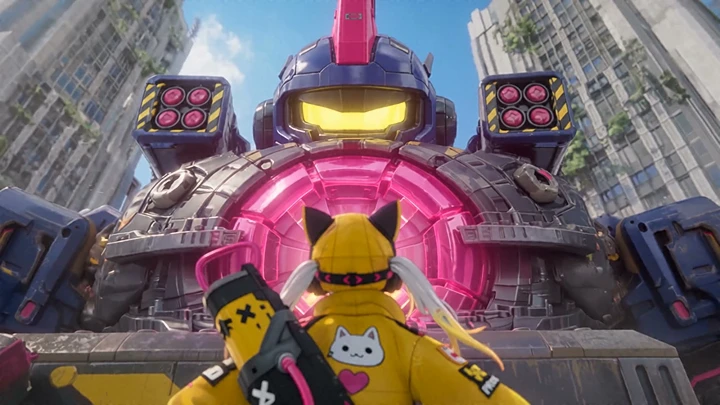
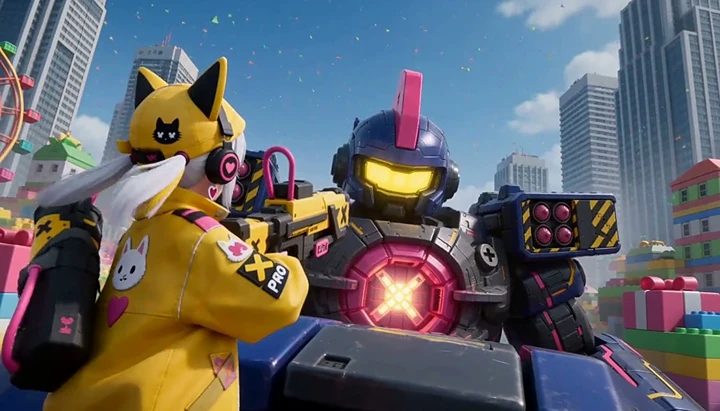
Complex game action requires a model to preserve visual references while coordinating multiple dependent movements. A visually spectacular battle is not necessarily a successful generation if the characters lose their identities, relative scale changes, or the intended combat sequence becomes impossible to follow.
Both clips preserve a small yellow heroine against a much larger blue-and-pink toy mech, so relative scale is readable. Wan 3.0 keeps the supplied design cues more stably — yellow cat-ear cap, bomber jacket markings, and the mech's pink core and missile pods stay checkable while she climbs and fires. MiniMax H3 also shows cannon fire, a climb, and a hit in a colorful toy city, but early frames can introduce a different yellow figure before the heroine returns, so reference lock is less reliable. Choose Wan 3.0 when the character sheets and the combat order have to stay recognizable. Choose MiniMax H3 if the giant-versus-tiny toy-world energy is the priority and you will verify the heroine still matches your reference.
Reference Assets
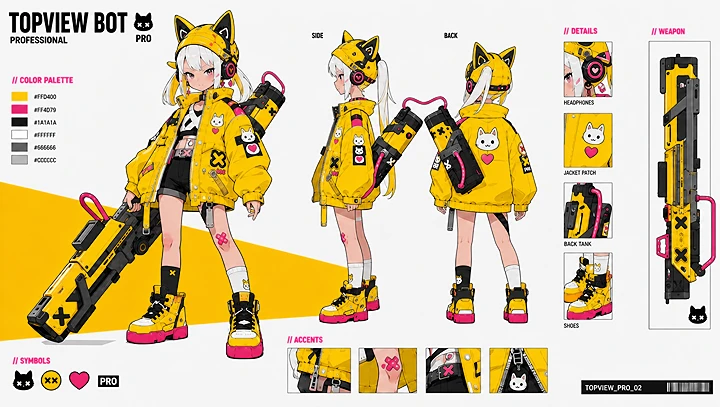
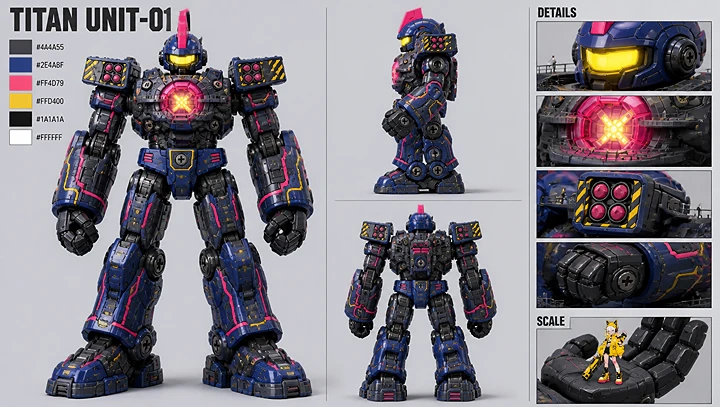
Toy-world giant boss battle CG, 15 seconds, one continuous take. Input references: <<<Image1>>> for character appearance — TOPVIEW BOT PRO exact costume and palette <<<Image2>>> for boss appearance — TITAN UNIT-01 final giant form, exact design and palette References are design sheets only: do NOT render the sheet layout, labels, swatches, scale panel or grey background. Extract character design only. Character lock (match <<<Image1>>> exactly, no changes): A small agile girl TOPVIEW BOT PRO with long silver-white hair in loose low twin tails, pale mauve eyes, calm focused expression. Yellow cat-ear cap with black inner ears and black cat face emblem, black and hot pink headphones with heart marks, heart earrings. Oversized yellow bomber jacket with black cat patches, PRO badge, X badges and pink hearts, white-black cropped top, pink belt with heart buckle, black shorts, pink heart mark on her thigh, mismatched socks, chunky yellow platform sneakers with pink soles. She carries a huge yellow and black toy cannon with pink handle and X markings, connected by pink cables to a back tank. Color palette locked: yellow #FFD400, hot pink #FF4D79, black #1A1A1A, white, grey. Boss lock (match <<<Image2>>> exactly): A hundred-meter toy titan mech in its tall heroic giant form, glossy injection-molded plastic and diecast materials, dense overlapping armor plates with oversized screws and molded seams. Deep grey and matte blue armor, blue helmet with hot pink crest raised above broad flat shoulder decks, glowing yellow eye visor, shoulder missile pods with yellow-black warning stripes and pink missile tips, pink-yellow energy lines, glowing chest core with pink X emblem set into layered chest armor plates forming flat ledges at varying heights — standable plates, deep seams, no man-made stairs or ladders. The titan is an active aggressive fighter: its head tracks her constantly, its fists strike and grab at her throughout the fight, servos whining with every motion. Environment: giant toy city battlefield — building blocks, gift boxes, toy trains, a Ferris wheel, teddy bears, plastic debris; realistic grey-white skyscrapers behind, bright blue sky, floating confetti. Timeline: 0.0–3.0s | Face-off Opening frame: seen from a low angle behind her — TOPVIEW BOT PRO stands with her back to the camera on a wide flat armor ledge beside the glowing X core, tiny against the titan's mass, facing up toward the helmet far above. Wind blasts through her twin tails and yellow jacket. She levels her cannon at the distant glowing visor. The titan's head tilts down, visor locking onto her and narrowing to a bright slit; both shoulder missile pods snap open with mechanical clicks. Camera: low-angle over-the-shoulder push-in past her toward the titan's head — her back to camera in the near foreground, the helmet towering above, shallow depth of field. 3.0–8.0s | Homing missile gauntlet The shoulder pods fire: missiles arc high into the sky trailing white smoke, then curve sharply downward and home in on her, chasing her path. She sprints up the titan's chest across overlapping armor plates, vaulting ledge to ledge as the homing missiles slam into the armor just behind her footsteps, each impact exploding into colorful plastic debris. The titan's left fist sweeps across its own chest to swat her — she slides under the passing fist without breaking stride, then fires once on the run, destroying the last missile behind her. Camera: fast side-tracking shot rising with her, wide lens, heavy motion blur, the sweeping fist and missile impacts crossing the foreground. 8.0–15.0s | Face-to-face point-blank finish As she reaches the shoulder deck, the titan's right hand rushes in to grab her — she leaps off the closing fingers, using the hand as a springboard, arcs through the air IN FRONT of the titan's face, and lands on the narrow brow ledge directly above the glowing yellow visor. She faces the titan's face head-on — her body turned OPPOSITE to the direction the titan faces, her back to the open sky, the huge visor glowing right in front of her. She presses the cannon muzzle horizontally against the center of the visor. The weapon charges yellow-pink energy for one beat while the titan thrashes — then she fires the beam horizontally straight INTO the face. The visor shatters inward, colorful energy bursts through every helmet seam, and the titan breaks apart into thousands of flying toy blocks and plastic pieces. She kicks off the collapsing face through the falling debris, landing on a giant tumbling block, still running forward. Camera: following her leap around to the FRONT of the titan's face, holding a frontal close shot — girl and giant face in the same frame, facing each other — during the charge and firing, then pulling wide as the mech shatters; follow her momentum through the debris. End frame: cut during her run across the falling blocks — no victory pose, no freeze frame, no fade. Style: AAA game boss battle trailer, stylized anime-inspired 3D CG, glossy toy materials, Ratchet & Clank + Astro Bot energy, extreme scale contrast between the small girl and the colossal mech, high saturation, cinematic rim light, physical debris simulation, motion blur, 24fps anamorphic widescreen. Audio: fast electronic rock, heavy drums, toy-box chimes, servo sounds, missile launch whooshes, homing missile whistles, sliding metal scrapes, cannon charge whine, massive beam impact, cascading plastic destruction; music cuts off mid-action. Avoid static camera, slow pacing, scene reset, character facing the camera in the opening shot, girl facing the same direction as the titan's head, girl standing on top of the head firing outward into empty sky, beam firing away from the titan, missiles flying away in straight lines, missiles appearing from off-screen without being launched, passive motionless boss, staircases, man-made steps, ladders, handrails, character redesign, hair or costume color change, blue jacket, bunny ears, weapon redesign, chibi proportions on the mech, rendering the reference sheet layout or text, extra limbs, distorted face, bad hands, subtitles, watermark, UI, gore, desaturated colors, slow-motion ending.
We evaluate whether each model completes the intended creative task — not simply which output looks more impressive at first glance.
Each comparison uses its original prompt and source materials. Where both models support the same inputs, the intended creative brief remain consistent. If accepted input formats or settings differ, those differences had been documented rather than treated as identical testing conditions.
We record the model version, generation mode, requested duration, actual output duration, resolution, aspect ratio, audio settings, and test date. A Wan 3.0 output at 720p and a MiniMax H3 output at 768p won't be treated as an identical-resolution quality test.
Evaluate whether the requested subjects, actions, dialogue, camera movements, and ending scenes appear in the intended order.
For reference-based tests, compare character faces, outfits, products, props, and environments against the original source assets.
Review camera movement, object interactions, body motion, action transitions, and cause-and-effect relationships. Look for unexpected scene resets, identity changes, and spatial inconsistencies.
For dialogue and music-driven tasks, evaluate spoken words, speaker attribution, lip synchronization, soundtrack preservation, and timing between sound and visual actions.
Separate successfully completed generation tasks from outputs that meet the intended creative requirements. Track failed tasks, accepted outputs, credits consumed, and generation time as different measurements.
Compare the cost of the actual workflow, not just the lowest advertised price per second.
Wan 3.0 and MiniMax H3 use Topview credits. The final cost depends on model variant, output settings, duration, generation mode, and account plan.
| Published Output Tier | Wan 3.0 | MiniMax H3 |
|---|---|---|
| 480p | 0.3 credits/sec | 0.15 credits/sec |
| 720p (Wan) / 768p (H3) | 0.5 credits/sec | 0.3 credits/sec |
| 1080p (Wan) / 2K (H3) | 1.0 credits/sec | 0.6 credits/sec |
The lowest per-second price does not always produce the lowest final production cost. Track all generation attempts, failed tasks, and how many outputs meet your quality requirements.
Cost per usable video = Total credits consumed ÷ Number of usable videos.
Review the current Topview pricing and the live generator credit quote before submitting a production job.
One Topview workspace. Two different creative workflows.
Choose Wan 3.0 for longer single-generation stories and reference-rich production. Explore MiniMax H3 for shorter audiovisual content, a supported high-resolution regeneration workflow, or eligible custom integration.
Compare the available settings, actual results, and generation costs before making your choice.